When an interest becomes an audience

Stefanie Maier of Süddeutsche Zeitung on turning audience interests into live experiences… and turning those experiences into loyalty.

Stefanie Maier will speak at the FIPP World Media Congress, 13-15 October, Madrid, Spain
Süddeutsche Zeitung is using live events to turn editorial interests into deeper audience relationships. Stefanie Maier discusses what makes a topic worth building around, why over-segmentation is a risk, and how SZ is trying to turn event participation into longer-term loyalty.
How did the idea of building loyalty around interests rather than the brand come about?
The audience insight is simple: we see that audiences often come to us first through topics and interests that matter to them, and not through the brand alone. At Süddeutsche Zeitung, we are placing a strong focus on SZ Live, our editorial events offering, and this is where that becomes especially visible.
If you build formats around topics people truly care about, you create stronger engagement and, over time, a closer connection to the brand.
How do you identify which ‘small worlds’ or niche audiences are worth building products around?
We look at a mix of audience demand, usage behaviour and topical relevance. For example, a strong signal is when we see high ticket demand in a short period of time. We also look at reading and usage habits to understand which topics connect strongly with our audiences and can be turned into strong successful live formats.
We use metrics like these to figure out whether a topic is relevant, timely and close enough to audience interests in order to create real engagement.
What’s an example of a product this thinking has led to?
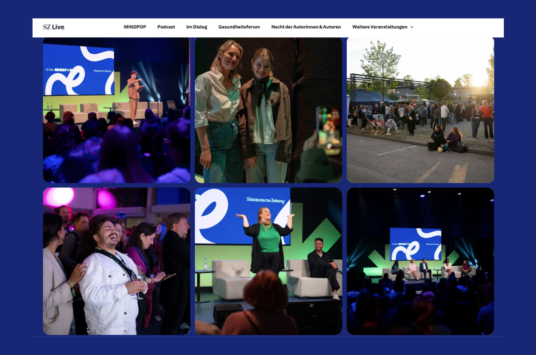
A good example is Mindpop, a festival we developed for a deliberately younger audience, roughly between 20 and 45. The concept was to build a format around overlapping audience interests rather than a single theme.
We brought together a wide range of social, cultural and everyday-life topics – such as feminism, comedy and climate – in one programme, because that reflects much more closely how audiences actually engage with content and where they see relevance.
What made Mindpop stand out was this curated mix. Instead of creating highly segmented standalone events, we developed one format that connected different but related interests and created a stronger, more inspiring overall experience for the audience.
What are the risks or trade-offs of this kind of segmentation?
The main risk is over-segmentation. Not every strong topic should automatically become a separate event. If you become too narrow, you can lose scale, efficiency and the wider brand effect.
So the challenge is to create relevant offers for specific audience interests without losing the broader brand connection.
What tells you this is building long-term value, rather than simply attracting people to individual events?
We see it in both quantitative and qualitative signals. Strong ticket demand is one indicator, but so is active participation and recommendation.
Another important question is whether an event becomes part of a broader user journey – for example, whether we can convert event users into subscribers. That is when engagement starts to create long-term value.
What’s next for this strategy at SZ?
We will continue to invest in live communication and to make a broader range of topics available as experiences in different formats. The traditional panel discussion alone is no longer enough.
We are increasingly extending strong editorial themes and editorial series into live experiences. On the partnerships side, we want to build more strategic collaborations that go well beyond logo exchange and create real added value for audiences.
What do you think audiences need most from publishers at the moment?
I think the immediate focus should be on relevance, connection and dialogue, which is a strategic priority for Süddeutsche Zeitung.
Audiences increasingly need help making sense of a complex world, so we do not see events simply as another channel for telling our stories, but as a space for genuine exchange with our audiences.
For me, that means thinking more carefully about audience needs, creating meaningful formats and building long-term relationships.